The problem with most business books – and we’ve read enough of them by now so we should know – is that they posit one golden template that must be applied to all businesses in all states of crisis, ad infinitum amen. These books are generally born from the success of one person in one particular industry, a success – perhaps unforeseen and perhaps which overcame great odds to catapult the author to celebrity-hood – which now becomes the hammer with which he deems every business obstacle the same god-damned nail.
Got a problem? Just do what I did! Got a different problem? Well, see, that’s where you’re wrong! Actually, your problem is the same problem I had – so do what I did! Can’t figure out how to twist your problem into something resembling my problem so my solution works for you? Well, there’s your problem! You’re just not very good at this business stuff! Because if you were, you’d understand that the problem isn’t what you think it is, it’s what I think it is, and it’s solved by following the steps laid out in my book.
And it’s clear why authors do this. Humans are, after all, remarkably unempathetic creatures, beings who tend to believe that everyone is fundamentally like them, having had the same experiences, opportunities and assets. So, hey, if this worked for the author, how could it not work for you?
But even if the author could acknowledge that they are not everyman and their problem everyproblem (which, yeah, no), this “method”, these “insights” are what got them to the big dance. Why in the name of Jack Welch would they change them NOW? This is what got them on the cover of “Successful Businessperson Monthly” and invited to all those nifty parties with all those real celebrities. Why would they suggest some other plan, when this is the one they’re riding?
But perhaps most importantly, their success, their observation, their whatever, no matter how minor and obvious, is, if nothing else, a terrifically great organizer. I mean, if they let on for even a second that, well, every business is different, and therefore every problem they face might be different, well, then how do you bring the manuscript in at anything under ten thousand pages? And forget about the folks at CNBC having you on their chat show even if you do.
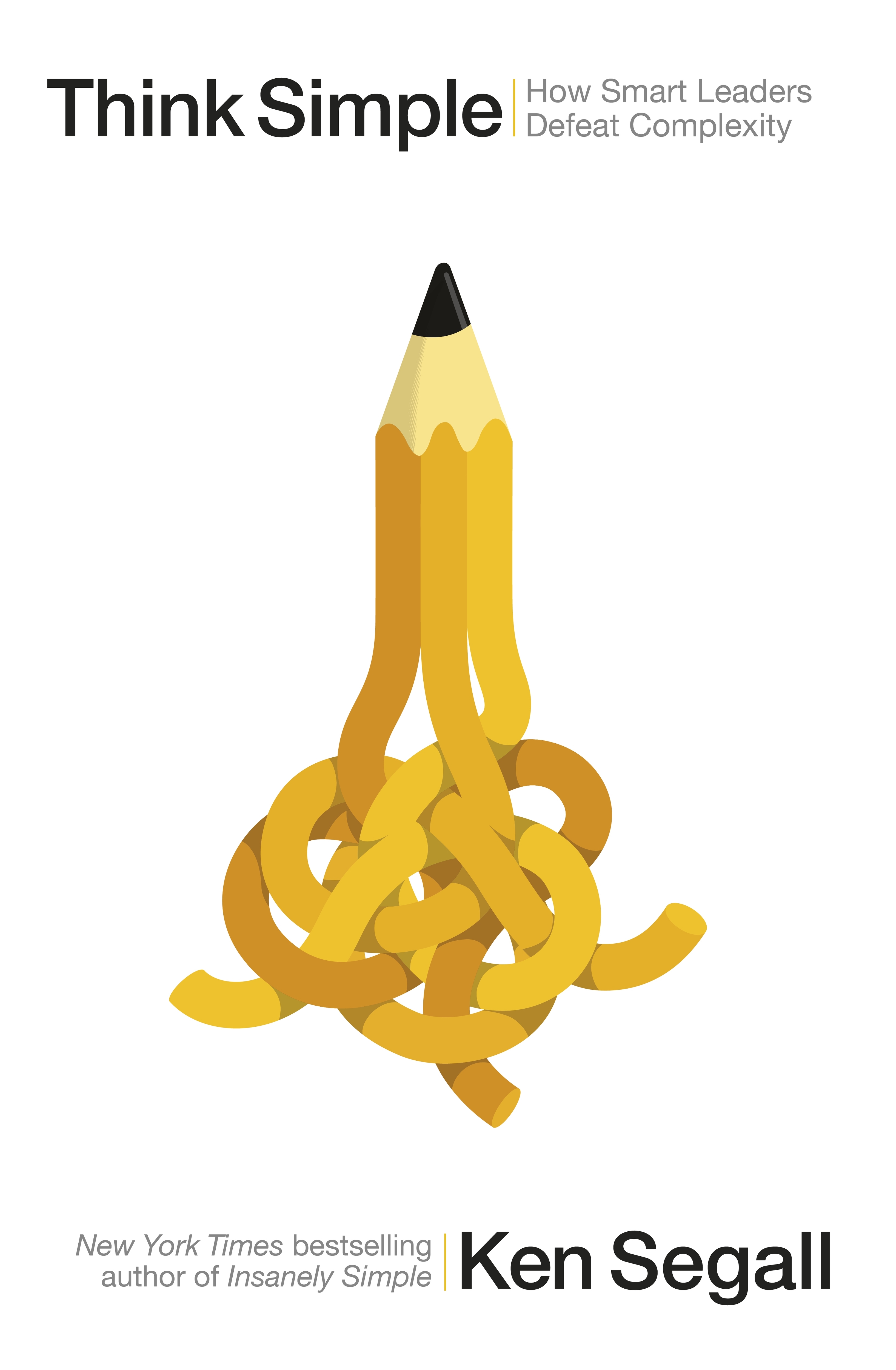
What is therefore so refreshing about Think Simple, Ken Segall’s follow-up to his bestselling Insanely Simple (which we reviewed here), is how he finds a very smart third path around these problems. He has an insight (born out of his work with Steve Jobs, of course), which is sort of the guiding principle that he suggests you work towards. But he accepts – indeed advertises – that businesses are different, and therefore the way they use this guiding principle will invariably be different.
Shocking, right?
Oh and that guiding principle? Well it’s simplicity, of course. But, as Segall writes early in the book, it’s not as simple as the term implies:
What we’re talking about is the perception of simplicity. It’s what the customer takes away from the experience.
And this is an extremely important distinction that is often lost on those who wish to emulate Mr. Segall’s famous client. For what Segall is advocating is a rigorous dedication to putting yourself in your customer’s shoes and making sure that their engagement with your business – at every possible touchpoint up to and including your product – is dead simple for them. Intuitive. Clear. And if this requires – as it invariably will – that the “back end” of your business (the part the customer never sees) is more complicated than a Jackson family reunion, well, that’s fine. That’s the cost of having a successful business. Because all that matters is that, from the customer’s perspective, it’s simple.
Now, to this point you’re probably thinking – sounds pretty hammer and nail so far. But here’s the difference – the how is flexible based on your business. Which becomes very apparent through Segall’s interviews with business leaders on multiple continents in multiple industries. How Westpac bank in Australia made their customers feel things were simple is different from how Hyundai did it in South Korea is different from how DirecTV did it in Latin America is different from how The Container Store did it in the U.S. – all of which are different from how Steve Jobs did it at Apple. Because the nature of those businesses is different. What they sell is different. How they are structured is different. What internal challenges they face are different.
And to be clear, figuring that out is not easy. Figuring out what the customer wants, what they will find intuitive, that takes a particular bit of brilliance. And, as we have said elsewhere, this, actually we believe, was Steve Jobs’ real genius. To figure out the need.
Segall offers some tips for getting to this, not the least of which is starting over. Thinking about your business from scratch, which necessarily focuses you on the customer. If people buy a hole, not a shovel, then what is the hole they need for which you’re selling them a shovel?
And how you accomplish this “thinking about your business from scratch”, of course, requires some principles which Segal again is flexible with. You must have a clear vision of what the customer’s view is. You must have one person driving that bus. And that person must have full support and authority to make it happen. But what that vision is, who is who’s driving the bus, and how the full support and authority are applied – well that’s all up to you, your company and your business.
And of course, your C-suite – which is likely not interested in doing any of these things.
That’s because simple is not easy. That’s because simple is hard. But that’s exactly why simple is – or at least, can be – your competitive advantage. Like it was for Apple.
It’s just that simple.
Think Simple by Ken Segall was published by Penguin: Portfolio on 06/07/2016 – order it from Amazon here, or from Barnes & Noble here, or pick it up at your local bookseller (find one here).
Please be advised that The Agency Review is an Amazon Associate and as such earns a commission from qualifying purchases
You May Also Want to Read:


 The Agency Review