We like to think that things are monolithic. Institutions, organizations, companies. We like to think that, in a sense, they always were and they always will be. Perhaps we do this to provide ourselves with islands of order as everchanging life swirls past us. Perhaps it is comforting, or perhaps it merely keeps us from losing our minds, when we identify a mighty oak that we can reliably grab hold of, or an unwavering Polaris that we can use to guide ourselves home.
Sport is one such monolith, and for Americans, baseball is often the monolith of choice. It returns every Spring like Persephone; it disappears every Autumn like her too. It started before you were born and it will likely continue long after you die. However many teams made up the Major League of your youth, these are the “proper” number and subsequent additions are upstarts and adjuncts to the “true core” – no matter how many World Series’ rings they may have won, no matter how many your team has not.
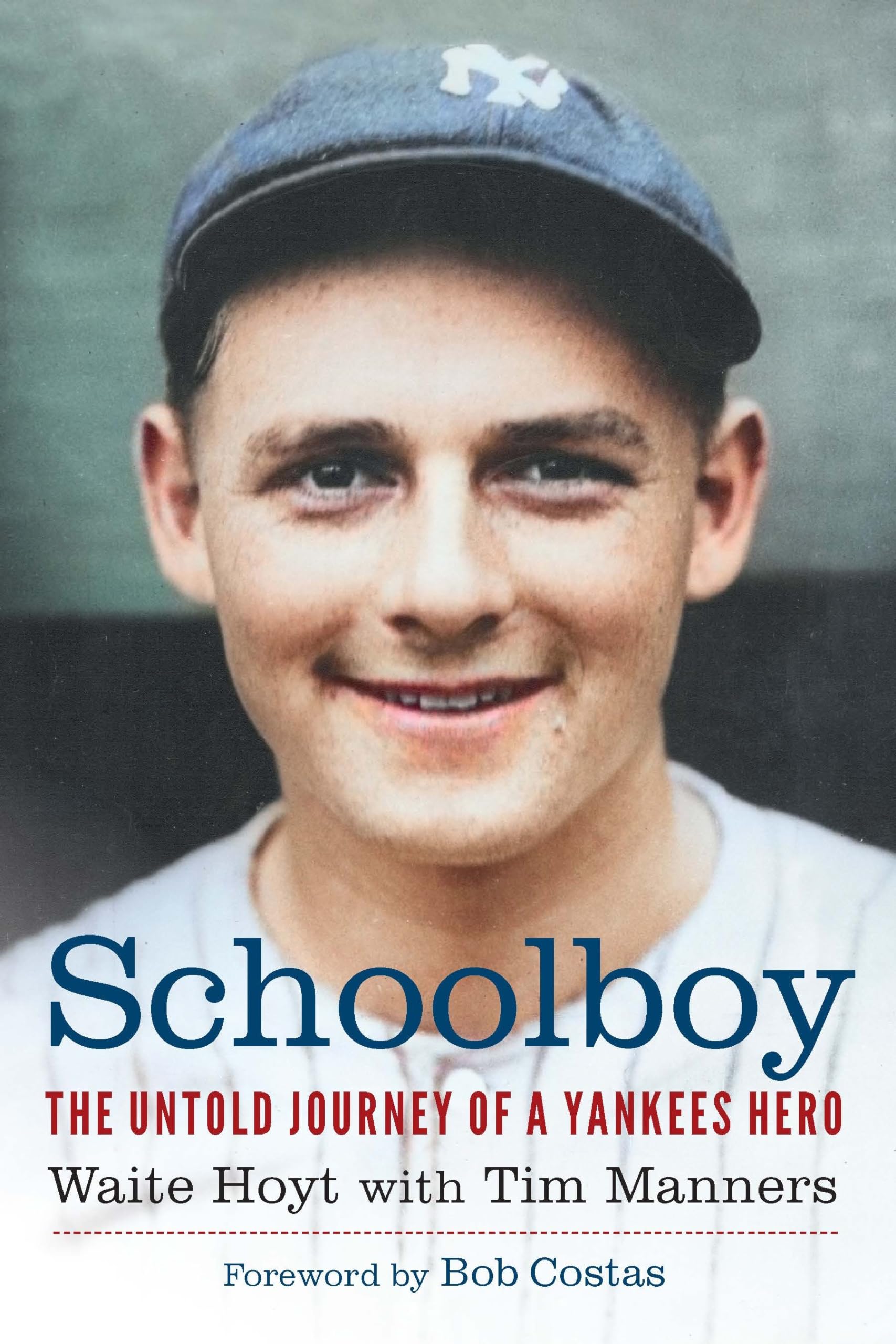
Thus one of the values of a book like Schoolboy, by Waite Hoyt with Tim Manners, is the way it shines light onto the less intractable aspects of this monolithic sport. For no matter how much the league or the commissioner or the networks or even the government tries to convince us that it is as enduring as the Appalachians, invariably its early days were entrepreneurial, arbitrary and often highly iterative. There were fits and starts. There was hyperbole and catastrophe. There were dead ends that forced all involved to retrace their steps to re-find that fork in the road that led them here, so they can choose a more fruitful road to head down.
Thus, Schoolboy, the memoir of pitcher Waite “Schoolboy” Hoyt, who, alongside teammates Babe Ruth and Lou Gehrig, won three World Series with the New York Yankees (1923, 1927, and 1928), spent almost 20 years in the major leagues with eight different teams, was an announcer for 24 years with the Cincinnati Reds, and was inducted into the Baseball Hall of Fame for all his trouble in 1969.
And what’s instructional about Hoyt’s memoir is it reminds us that this is how life actually works. Life itself is iterative, full of fits and starts, full of strange pathways to success. The problem, however is that we tell ourselves it’s not. We tell ourselves that it’s too late to start over, or to start at all, that we’ll never catch up to those who currently dominate our landscape. So we don’t try. Or worse, we try, and fail, and take that failure as utter and complete. But it’s not, not unless you want it to be. And books like this – whether they were intended to or not – remind us of that. That every large company suffered setbacks that made it rethink its premise, offering and structure, and undoubtedly is not today precisely what it set out to be in that first Power Point deck. Because that’s how learning works. It’s only a straight line when you look in the rearview mirror. As you’re living it, each steppingstone looks like the end of the line. Until it isn’t.
Like with Hoyt. He started out pitching for Erasmus Hall High School in Brooklyn but won titles in the Newspaper Leagues there (baseball leagues so obscure, it’s hard to even Google them). When the Brooklyn team in the Federal League (which existed from 1914 to 1915) heard about him, they asked him to pitch batting practice. When they offered him a minor league contract, his family rejected it because Waite was only 15. So his career is over, right? Except the National League’s Brooklyn Robins (later known as “the Dodgers”) ask him to pitch batting practice for them. Which he does, though they don’t offer him a contract. Career over again, right? No, because his father knows someone at the New York Giants, so he pitches batting practice for them.
And they sign him – to their Lebanon, Pennsylvania minor league team in the Eastern Association. And he’s still only 15. When the Eastern Association folds in 1914, the Giants send him to the Hartford Senators in the Colonial League – until that league collapses in 1916. And then it’s to the Memphis Chickasaws in the Southern Association and then to the Montreal Royals in the International League when he was 18.
That’s seven teams in six leagues – three of which folded – in three years. And none of these are counted among those 8 teams he played with in the Majors. Fits and starts indeed.
Even the book itself is iterative. Waite Hoyt filled eight bankers boxes with pages but never completed his memoir before his death in 1984. It wasn’t until his son Chris sent the boxes to his old friend Tim Manners that we got the book at hand.
Late in Schoolboy there’s this interesting paragraph:
I look upon my life – or the thread of it – as a boy born of good, attentive, middle-class parents who were guided by the moral codes of their day. Their big mistake was allowing me to venture into a world while still innocent, uninformed – naïve – with a character and personality susceptible to temptation that was exercised after association with the more uncivil, rugged, abrasively unsophisticated men with whom I was thrown in my younger years of professional baseball.
That paragraph is interesting because that’s why life has to be iterative. Because you don’t know what’s next. Look, Hoyt’s parents did a fine job, but they planned for a life in Brooklyn in the late 19th century – which had no relation to the life he ended up living. You can’t plan for that. You can only prepare – which is to say, you can only develop the skills necessary to respond nimbly and smartly to an uncertain world and your ever-changing path within it.
Instability is the rule. We fail and start again. Anyone who tells you otherwise is either ignorant of history or has a vested interest in making you feel bad about your efforts.
On some level, whether he realized it or not, Waite Hoyt understood this, for his memoir is an ode to reinvention and adaptation. His co-author Tim Manners – who does yeoman’s work crafting a highly readable work from eight boxes of notes – clearly does too.
Now it’s your turn.
Schoolboy by Waite Hoyt with Tim Manners was published by University of Nebraska Press on 04/01/2024 – order it from Amazon here, or Barnes & Noble here, or pick it up at your local bookseller (find one here).
Please be advised that The Agency Review is an Amazon Associate and as such earns a commission from qualifying purchases
You May Also Want to Read:


 The Agency Review