We have worked at a lot of agencies, both because we keep getting sacked and because we freelance, and it has been our experience at the vast majority of them that New Business is a gold plated shitshow. Underfunded, last minute, desperate, and generally the purview of people so incompetent the agency has taken them off of actual paying clients for fear of damaging revenue and dropped them here, where they can either do less damage or from which they can lop off their heads after a suitable interval (“Sorry Jerry, but it’s been six months and you haven’t brought anything in and I just can’t keep carrying you any longer…”)
Add to this the fact that David Ogilvy was generally disapproving of the idea of dedicated New Business people (he would have and probably did, say “men” but I don’t feel like getting sued today), feeling, famously, that every person in his organization should be responsible for bringing in new business because “the best source of new business is old business”. And while I agree with the entrepreneurial spirit of that idea, I have found it generally to be the kind of passive aggressive lip service that most senior management use to shift the blame when things aren’t going well, and to better salve their consciences when planning the next round of layoffs (“Come on, Carl, you know we’ve needed new clients and yet you didn’t do anything to bring them in, have you? So I guess, in a sense, you have no one to blame but yourself.” Charming, no?)
So it either doesn’t get done, or it’s done poorly, or the agency hires an external “new business person” who everyone in the shop looks at with the same suspicion and doubt that every client looks at the new advertising agency that the new CMO brought in to help them get more customers. “Who is THIS clown? What does HE know about us? I bet he’s gonna make up some lies about us while charging an arm and a leg – and for what? What he brings in will barely cover what we’re paying him.” Ironic, ain’t it?
In other words (though those are some pretty good ones), new business is an eternal, perennial problem for advertising agencies for which there are no good solutions and no useful answers.
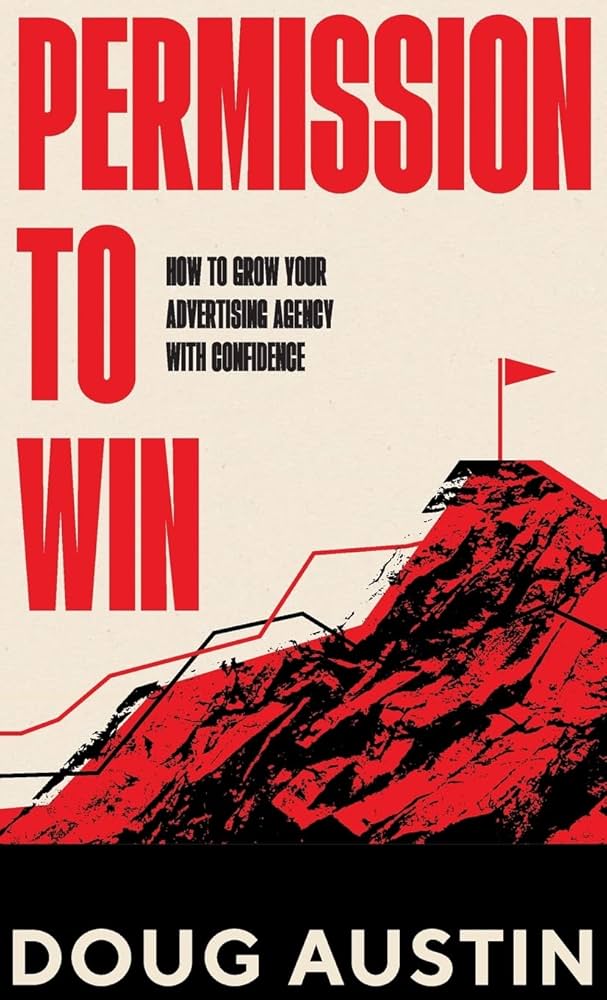
Until Doug Austin’s book Permission to Win.
Now, to be clear, this is not a perfect book, and sometimes the flaws distract from the message. But only sometimes. Austin’s book provides in many ways exactly the kind of step-by-step guide for developing a robust new business pipeline that agencies are in desperate need of. Valuable dos and don’ts that are the result of years spent generating clients for agencies and that you can take to senior management and say “If you really want new biz, this is what we have to do. And if you don’t want to do this, then stop wasting my time.”
Advice like “Understand the conversation of your clients’ industry and form expert opinions about it.” This isn’t simply the obvious old saw “know your client’s business”. This is more nuanced than that. This is about listening to what the industry is talking about, because invariably what they’re talking about is what concerns them, what keeps them up at night, what they don’t have answers for. And it’s not just the facts and figures or feeds and speeds that any monkey with access to google can look up. It’s the things that they have emotions about. Plus, if you know what they’re talking about, you can talk about it too – so you can engage them in a conversation. A conversation that doesn’t begin and end with how much they’re paying for their advertising now.
Advice like “We don’t have to take every initiation to participate in a pitch that comes along. Some of them aren’t worth it, and others are not winnable.” Which is extremely difficult for desperate agencies who are chasing revenue to understand. But it’s true. Some pitches will cost you more than you’ll earn back – whether we’re talking about revenue or culture or reputation. And others, others you don’t really have a shot at, for any number of reasons. Agencies who know who they are, and know what they’re good at will be able to tell which pitches are really in their wheelhouse, and not just in the wheelhouse of anyone with a spreadsheet and a copy of photoshop.
And observations like: “Services are bought, not sold.” Which should be stapled to the forehead of every advertising agency executive – in every department – in every agency in America. It means that while sometimes you can “push” a product on people (because if they don’t like it, they can throw it away), a service is different because it becomes a part of their life, and therefore is something they identify with on an emotional level. Customers know that, which is why you can’t push it on them; they need to “pull” it to themselves. Totally different mindset when you’re selling because it’s a totally different mindset when they’re buying. And advertising, as we know, is a service. So…
Look, the smartest thing we ever heard about new business (and if you said it, please contact us so we can thank you personally), is that no company embarks on a hunt for a new agency unless they’re in some sort of crisis. It’s too onerous, too costly, too emotionally exhausting and too disrupting to the company’s actual business to do it unless the company is on the verge of disaster. Permission to Win, in a sense, speaks to this insight, by constantly refocusing your efforts on identifying what that crisis is, and by doing things that don’t just position your agency as uniquely qualified to help them survive it and thrive – it actually makes your agency uniquely qualified to do it.
Which, you know, is essentially how we help clients frame themselves up for potential customers.
And no, the irony that most agencies don’t understand that and need a book like Mr. Austin’s to remind them how to do it for themselves, is not lost on us.
Permission to Win by Doug Austin was published by Austin Amplifies on 12/07/2021 – order it from Amazon here, or Barnes & Noble here, or pick it up at your local bookseller (find one here).
Please be advised that The Agency Review is an Amazon Associate and as such earns a commission from qualifying purchases
You May Also Want to Read:

 The Agency Review